India's research platform for standardized district-level data.

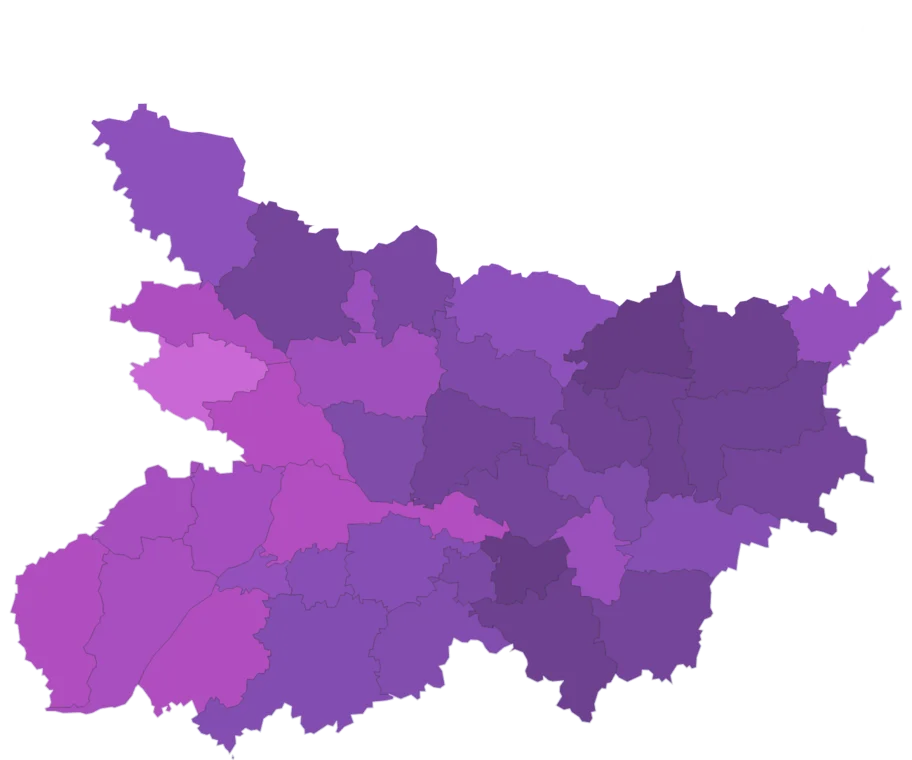
Skip the shapefile joins. 800+ districts and 85+ indicators from 10+ official sources, already reconciled onto one geography — map it, correlate it, and export it publication-ready.

What you need

Every public Indian dataset, one district geography. Start from the job in front of you.

The saving

Weeks of data preparation, already done. Eleven hours a layer, every layer, every project. It compounds.

Old way

11.2h

Shapefiles + QGIS · per indicator

01Download shapefile25 min
02Find the CSV40 min
03Fuzzy-match names3h
04Patch 2011 splits4h
05Join mismatched codes2h
06Style the ramp45 min
07Export20 min

Spatial India

~2 min

per indicator, every time

01Download shapefilealready done
02Find the CSValready done
03Fuzzy-match namesalready done
04Patch 2011 splitsalready done
05Join mismatched codesalready done
06Style the rampalready done
07Exportone click
01Pick an indicator
02Read the map

Steps 01–07 already done, once, for every indicator.

What you can build

12 sources, 89 indicators. Every one of them on the same 808 polygons.

Stack any source on any other. They already line up.Compare any two, district by district — your own upload against NFHS-5 or RBI-BSR
NFHS-525 indicators · 777 after crosswalkRBI-BSR11 indicators · 776 after crosswalkAgCensus11 indicators · 741 after crosswalkCensus14 indicators · 777 after crosswalkBase geography808 polygons
Track an indicator over time, period by period.Gurugram, Haryana · Dec 2014 → Mar 2026
Dec '14Mar '268.9× · INR Crores
Break a composite measure into its parts.Gurugram, Haryana · share of credit by sector
AgricultureIndustryTransportProfessionalPersonalTradeFinanceOthers

Your own data

Bring your own data and compare it with 85+ indicators

Layers

Women literacy
Improved sanitation
Bank credit
+ Your data

The data

Official sources, one geography, every estimate flagged.

NFHS-52019–21
Census2011
AgCensus2015–16
RBI-BSR2026
NCRB2022
NJDG2024
CVI2021
MSME2026
Amenities2011
eRaktKosh2024
GOBARdhan2026
VIIRS2012/2024

Joined on official LGD district codes, then normalised names, then 143 hand-curated aliases — your own uploads get their own table, 169 entries wide.

FAQ

Frequently Asked Questions

Yes, and citing is free — it is not behind a paid tier. Every map, table, and export carries the underlying source and year, so the primary citation is always to the original publisher (Census of India, NFHS-5, RBI, and so on). Where you are citing our crosswalk or a derived value, cite Spatial India alongside it — our citation page gives you a ready-formatted reference with the version and access date. All data is used under India's NDSAP guidelines.
This is the core of the work. Census 2011 covers 640 districts, NFHS-5 covers ~707 as published, and other sources use different names and vintages again — so we reconcile all of them onto a single frame of 808 districts. Where a district was created after its source was published, the value is either inherited from the parent district or estimated area-proportionally, depending on the indicator. Every such value is flagged in the interface rather than silently filled. The full method, including where it is weakest, is on the methodology page.
It varies by source, and we show the year on every layer. The Census is 2011 and remains the population denominator for per-capita metrics — we do not hide that. But NFHS-5 runs to 2021, night-time lights to 2024, and RBI credit and Udyam MSME registrations to 2026. Census 2027 fieldwork is underway and our ingestion path is already built for it.
You can, and it does not leave your browser. Upload a CSV with a district column and we match it against the same crosswalk the rest of the platform uses, showing you exactly which rows matched and which need review — then your data behaves like any other layer, so you can map it, correlate it, and rank it against public indicators. The file is parsed locally and never uploaded to a server; we record only that an upload happened and its row count.
Export any view as CSV and you get the district identifiers alongside the values, which is the crosswalk applied to real data. The standalone crosswalk file — district codes, names, parent relationships, and estimation flags — is being prepared for publication with a permanent DOI so it can be cited directly. If you need it before then, email us and we will send it.
The map is free, with no login or credit card, and citation and attribution stay free. Deeper analysis — full indicator access, correlation tools, bring-your-own-data, the credit timeline, and unwatermarked exports — will sit behind a subscription priced for Indian research budgets, not enterprise GIS budgets. Nothing is being taken away from what is free today without saying so first.
Absolutely — it's our primary roadmap milestone. Census 2027 fieldwork is underway, and our architecture is purpose-built to ingest and serve it the moment data is released. Spatial India will be among the first platforms in the country to make it interactive.

Join our early access list below to be notified when it goes live!

Stay in the loop

Be the first to explore Census 2027 data.

Get early access, new datasets, & India data stories — directly to your inbox.

Join 500+ researchers exploring India's district data